Cleaning an engine bay is less risky than most people fear, but more involved than spray-and-rinse. The step most videos skip is the dry clean — brushing and vacuuming loose debris before any liquid arrives — which stops grit being pushed further into crevices. The other consistent gap is electrical protection: the alternator is not the only component worth covering, and several videos cover only that one part.
Short verdict
For a first clean or a proper deep clean, start with ChrisFix: it is the only video here that runs every step in sequence across multiple vehicles, including a 20-year-old van. Watch The Car Care Nut alongside it for a clear account of what water actually damages and why — and as the only guide in this set for hybrid owners. If you want to skip water entirely, Chemical Guys shows a practical two-product maintenance method that removes all electrical risk.
The ranking
1
Best overall
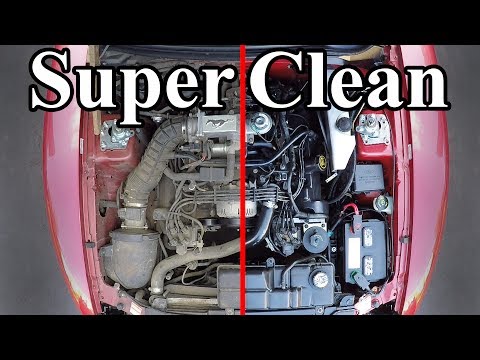
How to SUPER CLEAN your Engine Bay
ChrisFix · 21:58 · Jul 2017
ChrisFix works across three vehicles — a daily driver, a Jaguar, and a 20-year-old van — running four stages in order: dry clean with brushes and vacuum 5:33, wet clean top-down with degreaser and garden hose 10:15, blow-dry, then trim restoration. Battery disconnection, covering the distributor and sensors, and the hazard of cold water on a hot block 9:36 are addressed before any liquid touches the bay.
Why it ranks here: Ranks first because the dry-clean step 5:33 — the one most videos skip entirely — is shown at enough length to understand what it achieves. The hood liner is removed and cleaned separately 17:18, the water-based trim restorer is worked in with a brush rather than simply wiped on 18:55, and the car is started at 21:02 to confirm no warning lights. No other video in this set runs the full sequence on vehicles of such different ages and conditions.
~21 min · intermediate · brushes, vacuum or blower, garden hose, microfibre towels
2
Best safety primer — essential for hybrid owners
Never Do THIS When Cleaning Your Engine Bay! Do THIS Instead
The Car Care Nut · 20:35 · Nov 2023
Structured as an explainer rather than a walkthrough, The Car Care Nut covers gasoline engines first and then hybrid systems — including Toyota third- and fourth-generation inverters at 10:43 — working through which components are genuinely at risk and why. The recommended approach is deliberately restrained: compressed air, microfibre wipe-downs, and targeted degreaser rather than hosing.
Why it ranks here: The value is in the reasoning. The explanation of how water travels by capillary action into connectors 3:30–5:06, corrodes the contacts, and eventually breaks the wire is the clearest account of this hazard in the set — it makes the precautions stick rather than feel arbitrary. The hybrid section 10:43 is the only coverage in these twelve videos of the distinct risk posed by Toyota inverter systems, where a large repair bill is described at 11:47. Watch this before cleaning any hybrid.
~20 min · all levels · microfibre towels, compressed air optional
3
Best thorough walkthrough
How to Safely Clean Your Car's Engine Bay!
Pan The Organizer · 23:53 · Nov 2022
Pan The Organizer, drawing on 25 years of detailing experience, works through a complete clean using diluted all-purpose cleaner, a foam sprayer, multiple brush sizes, and a low-setting pressure washer for the rinse, finishing with a trim dressing. The pacing is unhurried enough to show the actual scrubbing — different brushes for different crevices, foam dwell time, working around a cold air intake — rather than cutting away from the difficult parts.
Why it ranks here: Where ChrisFix is most complete structurally, this is most useful for watching the hand work. Pan's point at 7:09 — that high-powered petrol pressure washers throwing 3,000–4,000 PSI are the real problem, while a low-setting electric unit is workable — is a more precise position than other videos take. Vacuuming first before any water arrives 3:38 aligns with ChrisFix and adds weight to that step. A commenter with over 20 years of automotive repair experience confirms that cars built after 2005 generally handle this process well.
~23 min · intermediate · brushes, garden hose or low-setting electric pressure washer, blower
4
Best concise right/wrong reference
Don't Just Spray Your Car's Engine Bay! Right and Wrong Way to Clean an Engine Bay!
1A Auto: Repair Tips & Secrets Only Mechanics Know · 7:24 · Jul 2021
Andy at 1A Auto demonstrates the major mistakes first — spraying a running engine 0:28, soaking the alternator 0:43, blasting the fuse box 1:16, hosing a hot block 1:45 — then walks through the correct method: pick debris by hand, vacuum, apply diluted degreaser away from electrical components, and rinse lightly. The whole video runs under eight minutes.
Why it ranks here: The demonstration format makes the prohibitions concrete. The warning at 2:10 — that spraying water over a displaced hose can hydro-lock the engine — is specific and appears in no other video in this set. The statement at 6:06 that engine bays are designed to get wet, just not under pressure, cuts through unnecessary anxiety. Good to watch after ChrisFix if you want a second perspective quickly.
~7 min · beginner · vacuum or blower, brushes, garden hose
5
Best waterless method
Easy Engine Bay Detailing - How To Wash Your Dirty Engine Bay With Two Products!
Chemical Guys · 14:21 · Sep 2023
The Chemical Guys presenter uses two products — Nonsense all-purpose cleaner and VRP dressing — applied with brushes and microfibre applicators, with no water at any stage. The target is anyone maintaining an already-clean bay, or anyone too uncertain about electrical components to risk water.
Why it ranks here: Fills a gap the other videos leave open: the routine maintenance clean that keeps a bay presentable between deeper washes. No water means no risk to connectors or coil packs. The presenter's care around the battery 4:27 — apply to the applicator rather than spraying directly — is a sensible detail, and VRP dressing 3:14 adds UV protection to plastics. A commenter confirms that Nonsense diluted 7:1 still cleans and foams effectively, suggesting the product stretches further than the video implies.
~14 min · beginner · brushes, microfibre towels — no water needed
Where the videos disagree
Can a pressure washer be used safely?
Silver Cymbal says not to use one at all. The Car Care Nut advises against directing water forcefully at any component. Pan The Organizer (2022) permits a low-setting electric unit but rules out high-powered petrol washers (3,000–4,000 PSI) at 7:09. Several commenters on AliMECH's video add that keeping the nozzle a couple of feet back has worked for them without problems.
Our read: A domestic electric pressure washer on its widest spray setting, kept at distance from electrical components, sits in the workable range. A garden hose on a broad fan setting is lower-risk and sufficient for most bays.
Is covering only the alternator enough electrical protection?
Silver Cymbal covers only the alternator before hosing the engine. ChrisFix, 1A Auto, and The Car Care Nut all list further components: ignition coil packs, the fuse box, the intake, battery vents, and exposed connectors.
Our read: Covering only the alternator leaves too much exposed. The broader list — alternator, coil packs, closed fuse box lid, and intake — represents the reasonable minimum before any water enters the bay.