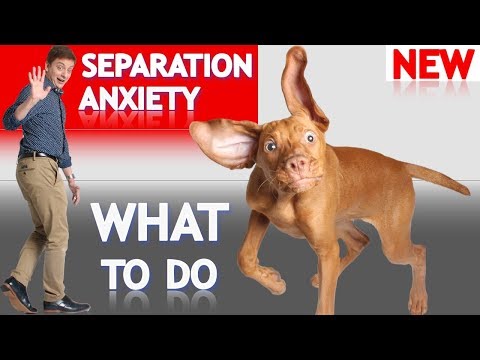
Separation anxiety can wreck a dog's day and an owner's confidence in equal measure. Most training videos concentrate on one tool — a Kong, a crate — without explaining how the pieces connect or what to do when the method stalls. The videos that genuinely help address the departure ritual and the relationship pattern that keeps the cycle running.
Short verdict
Start with Rachel Fusaro. Her video covers more practical ground than any other in this pack, from spreading attachment across household members to making the room the dog is left in somewhere it actually wants to be. She is also honest about where her advice ends and a professional behaviourist begins. If your dog starts reacting before you have even touched the door handle — pacing when you pick up your keys, trembling when you reach for your jacket — add the Zak George departure-cue video next. For owners who want the evolutionary 'why' before they start training, Cesar Millan's explanation video provides a clear foundation worth watching first.
The ranking
1
Best overall
SEPARATION ANXIETY: WHAT ACTUALLY HELPED MY DOG
Rachel Fusaro · 13:57 · Mar 2020
Rachel Fusaro draws on her own experience training her Labrador Bentley through genuine separation anxiety — a dog that would 'scream and scream' when left alone. Her core practice, which she calls 'practice the distance' 3:15, builds from seconds-long absences to longer stretches across different rooms, and she works through an error many owners overlook: Bentley had started associating going upstairs with being put away, so she had to decouple that staircase from departure entirely 6:41. She also covers spreading daily care across multiple household members, mental stimulation through scent games and frozen Kongs 7:46, and the calm return: no eye contact, no excited greeting until the dog has settled 5:03.
Why it ranks here: Fusaro is the only presenter here who worked through prolonged SA with her own dog and built her system from that experience rather than a demonstration. The tips are graduated and specific — she does not just say 'start small', she explains why starting small matters (the dog learns that absence has a ceiling and that you always return). She also acknowledges the owner's own anxiety, which none of the others do. Her admission that she is not a trainer 10:04, paired with a direct recommendation to seek a positive-reinforcement trainer or integrative vet for severe cases, makes this the most trustworthy starting point for someone who does not yet know how serious their dog's problem is. The calm-return instruction at 5:03 is the same principle covered in Will Atherton's 60-second clip, but here it sits inside a full training framework.
~13 min · personal case study · suits mild to moderate SA · presenter is not a professional trainer
2
Best for departure-cue desensitisation
What To Do About Your Dog's Separation Anxiety
Zak George’s Dog Training Revolution · 10:32 · Feb 2018
Zak George uses a young Vizsla puppy to demonstrate how to unpick the triggers that predict departure — picking up keys, putting on a jacket, moving towards the door — so those actions stop signalling 'I'm leaving' 5:01–6:12. He cites a Tufts University School of Veterinary Medicine study of 400 dogs 3:29 and a PLoS ONE finding that the single largest factor associated with separation anxiety was the amount of exercise the dog received 4:34–4:38. He also addresses the specific case of dogs whose anxiety is severe enough to make crate confinement dangerous, recommending a dog-proofed room as an alternative 8:08–8:16.
Why it ranks here: No other video in this pack specifically drills the pre-departure trigger routine: picking keys up and putting them down again, putting on a jacket and then sitting back on the sofa, so that those cues lose their predictive power. The PLoS ONE exercise citation adds weight to advice that every video gives but few justify. The puppy used in the demonstration is young and not severely anxious, which limits how much of the technique you can see applied under real pressure; George acknowledges the process can take weeks to months in serious cases 8:54–8:59. The sponsored opening segment runs to around 1:19 and can be skipped.
~10 min · demonstration with a young puppy · contains sponsor segment [0:00–1:19]
3
Best for understanding the 'why'
Explaining How To Fix Separation Anxiety With Your Dog
Cesar Millan · 14:24 · Jun 2020
Cesar Millan opens by explaining that following a pack is a dog's natural state and that living with humans who leave for work is an evolutionary mismatch — not a character flaw in the dog 1:15–2:00. His practical technique is the 'point of reference': a specific spot, such as a mat or dog bed, that the dog is consistently sent to throughout the day so that waiting alone in that place begins to feel normal rather than distressing 6:00–8:08. As a first exercise, he asks owners to count how many times their dog follows them in a single day, then cut that number in half 5:19–5:26.
Why it ranks here: The conceptual framing here — that SA follows from owners inadvertently teaching dogs that constant togetherness is the baseline — makes it easier to approach training with patience. One commenter put it plainly: 'I love how you explain WHY the dog does/feels what he does. It really helps to be more patient with them.' The point-of-reference technique is the most distinctive idea in this pack; no other video uses a fixed physical anchor in quite this way. One limitation is clear: the demonstration dog is calm and well-trained throughout. A commenter noted this directly — 'This dog appears well trained calm & not anxious one bit' — so you will not see the technique tested against a dog that is genuinely struggling.
~14 min · conceptual and practical · suits all severity levels as a first framework
4
Best for puppy owners
How to Prevent and Treat Puppy Separation Anxiety | Chewtorials
Chewy · 2:54 · Jul 2021
Kaleb from Chewy runs through five numbered steps with a calm puppy called Rudy: sizing the crate correctly, stocking it with chews and a water dish, tiring the puppy out with exercise, easing into short absences by stepping just outside the room and returning with treats 1:13–1:33, then working up to longer stays. The video closes with a clear instruction to ask a vet for help if the puppy still appears stressed on return 2:10–2:14.
Why it ranks here: At under three minutes this is the most efficient introduction to the basics. The numbered structure makes it easy to follow in real time. For a new puppy owner unsure whether they are dealing with normal adjustment or genuine anxiety, this is a usable framework without overwhelming detail. The direct signpost to a vet 2:10 — an off-ramp that other short videos omit — keeps expectations realistic.
~3 min · puppy-focused · no prior training knowledge needed
Where the videos disagree
Is separation anxiety driven primarily by the owner's energy and lack of clear guidance, or is it a conditioned fear response in the dog?
Cesar Millan frames SA as a consequence of unclear leadership and the owner's anxious energy: the dog has never been taught that waiting alone is acceptable, so it is not. The fix is calm, consistent assertiveness. Zak George and Rachel Fusaro treat it as a fear conditioned into the dog over time — the dog has learned that departure predicts distress — and the fix is systematic counter-conditioning using positive reinforcement.
Our read: Both approaches converge on the same practical steps: calm departures, calm returns, and incremental increases in alone time. The underlying explanation differs, but since the recommended training behaviours overlap substantially, this is a framing disagreement more than a practical one. Use whichever explanation makes you more motivated to train consistently.