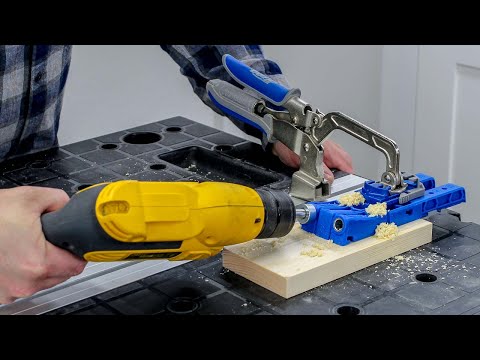
Pocket hole joinery is the fastest way to join two boards at an angle without waiting for glue clamps to set. Most videos spend their time on jig setup and screw size, then stop. The two things they skip — which direction the screw should point relative to the wood grain, and how seasonal wood movement stresses a joint made across a wide solid-wood panel — are the ones responsible for most failures.
Short verdict
Workshop Companion's Pocket Holes Overexplained is the one video that covers the mechanics, grain direction, wood movement, strength testing, and gluing technique in one place. For a shorter entry point, Steve Ramsey's beginner guide handles the practical steps in eight minutes with no waste. Before using pocket holes on any solid-wood project with boards wider than about 75 mm (3 in), watch The Evening Woodworker on when not to use pocket screws. It covers wood expansion in a way none of the other ranked videos do.
The ranking
1
Best overall
Pocket Holes Overexplained
Workshop Companion · 18:54 · Aug 2022
An 18-minute deep dive by Workshop Companion that runs a home strength test comparing mortise-and-tenon, biscuit, and pocket joints — the pocket screw let go at 48 kilograms 3:19 — then explains the terminology for grain surfaces, screw mechanics, three jig options including the Kreg and General, and an alternative drill-press method for those without a commercial jig. The gluing section shows how to pre-coat end grain for ten minutes before assembly 15:47 so the glue bonds what it can rather than being wicked straight into the wood.
Why it ranks here: The grain direction section 5:26–7:00 explains the mechanics of why end-grain screwing fails — short cellulose segments that offer nothing for threads to grip — which makes the rule stick rather than just being a rule to memorise. No other ranked video explains why the same joint configuration can be strong or weak depending on where the screw threads end up. Commenters with several years of pocket hole experience describe it as the best explanation they have encountered. The South Park-style animation helps, but the density of the content is the actual reason to watch.
~18 min · comprehensive · beginners and experienced users
2
Best for beginners
Beginner's guide to pocket hole joinery | WOODWORKING BASICS
Steve Ramsey - Woodworking for Mere Mortals · 8:10 · Feb 2016
An eight-minute introduction by Steve Ramsey that explains why pocket holes work — driving at an angle into face grain avoids the weak cellulose ends of a board — and walks through stop-collar setup on the drill bit 3:07–3:27, screw selection (fine thread for hardwoods, coarse for softwoods and plywood 4:55–5:07), clamping to prevent boards shifting during assembly 5:11–5:19, and clutch settings to avoid overdriving screws 5:39–6:06. Hiding pocket holes with plugs or wood filler is also covered.
Why it ranks here: A commenter notes it is "probably the ONLY video" they found that explains drilling direction and why the screws should go into face or edge grain rather than end grain — and that observation holds up against the other ranked videos. The pace is deliberate without being slow, and multiple comments from 2016 through 2024 confirm the technique remains accurate. The workbench looks like a real person's, which makes the methods feel attainable for a first-time user.
~8 min · beginner · Kreg tools shown, technique applies broadly
3
Essential for solid-wood projects
When to NOT use pocket screws... and when you SHOULD! | Evening Woodworker
The Evening Woodworker · 9:28 · Sep 2021
A nine-minute video by The Evening Woodworker built around one central point: wood expands and contracts across its width as humidity changes, and pocket screws driven across the grain will either crack the wood or push the joint apart over time. The video works through which joints are safe (plywood anywhere, face frames, narrow same-direction boards) and which are risky (wide solid-wood panels), and covers when tabletop fasteners are the right alternative to pocket screws 5:09–5:39.
Why it ranks here: The straw analogy for wood fibres at 0:12 makes the expansion rule concrete rather than abstract. When the video says at 2:53 "this is bad, this is good" with a side-by-side demo, the point is hard to forget. A commenter with 30 years of woodworking experience says no one had ever explained wood movement to them this way before. If you are building anything with wide solid-wood boards — a tabletop, a cabinet side, a shelf — watch this before drilling a single hole.
~9 min · intermediate · essential before any project with wide solid-wood boards
4
Best for troubleshooting
Pocket Hole Mistakes to Avoid / Woodworking Joinery
WoodWorkWeb · 13:56 · Feb 2020
A 13-minute mistake-focused walkthrough by WoodWorkWeb covering jig calibration, drill bit setup, bit sharpening with a diamond plate 2:36–3:10, joint strength across different materials — MDF, plywood, pine, oak 4:34–5:12 — pre-coating end grain before gluing 5:40–6:08, outdoor projects and why standard glue fails on cedar 6:18–6:36, clamping to keep boards flush, and a detailed side-by-side of proper pocket screws versus drywall screws. In hardwood, a drywall screw will snap its own head off 10:04.
Why it ranks here: The screw section justifies the watch on its own. A cut-away view shows exactly what a washer head does that a drywall screw's bugle head cannot, and the live demo of a head snapping in oak makes the point immediately. The material-strength comparison, even if imperfect (see flag), gives a useful sense of how much the wood species matters. Practical and specific at every step.
~13 min · beginner to intermediate · applies to any pocket hole jig
5
Best quick start for Kreg 320 owners
How to Use a Kreg Pocket Hole Jig 320
Scott Saws on Skates · 4:25 · Sep 2019
A four-and-a-half-minute demonstration by Scott Saws on Skates covering the exact setup steps for the Kreg Pocket Hole Jig 320: matching the stop collar to the thickness gauge 0:41–1:04, setting the thickness stops 1:04–1:19, drilling, then driving screws with a clutch-equipped cordless drill at low speed 2:09–2:21. The jig is shown reconfigured for a 1×2 board 2:49–3:05 and with the thickness stop removed for repairs in tight spaces 3:25–3:52.
Why it ranks here: The video moves fast and wastes nothing — commenters describe it as "no BS" and one says the video sold them on the jig entirely. The repair-in-tight-spaces section at 3:27 is not covered in most other pocket hole videos. If you own a Kreg 320 and want to be drilling in five minutes, this is the one. It does not cover grain direction or wood movement, so pair it with another ranked video for any project involving wide solid-wood boards.
~4.5 min · quick reference · Kreg Pocket Hole Jig 320 specific