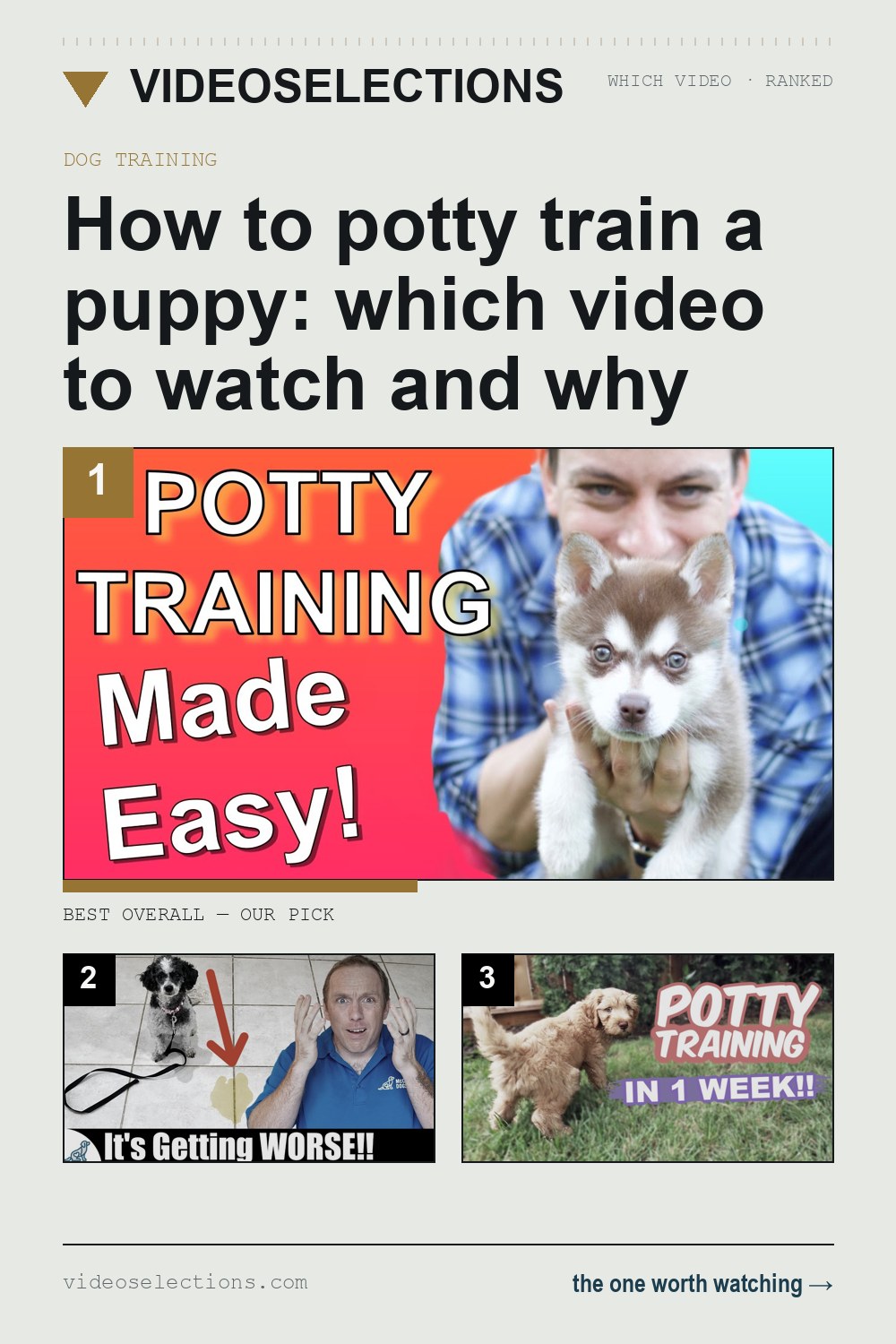
Most potty-training videos nail the outdoor schedule and leave the indoor half to chance. The harder part — what you do in the fifty-odd minutes between trips outside — is where accidents actually happen, and where most newcomers lose ground. One thing almost every video glosses over: puppies often do not fully empty their bladder on the first go outside, which explains the baffling experience of a puppy weeing in the garden, trotting back inside, and immediately weeing on the carpet.
Short verdict
Start with Zak George's Dog Training Revolution for the complete mental model. It covers environment management before schedule and gives an honest account of how long house training actually takes. Then watch the first McCann Dog Training video to address the supervision gap — it explains what to do with your puppy while they are inside, which is where the real training happens. If you want the practical hacks that make the daily grind easier, Rachel Fusaro's fast-training video is the third watch.
The ranking
1
Best overall
How to Potty Train your Puppy EASILY! Everything you need to know!
Zak George’s Dog Training Revolution · 9:47 · Feb 2016
Zak George walks through the full house-training framework with a real puppy (BB-8), demonstrating crate introduction by luring rather than forcing and explaining the environment principle: give your puppy access to one room at a time, earning the rest of the house as they prove reliable. The video covers schedule, crate sizing, night-time trips, positive reinforcement when going outside, and how to respond to indoor accidents.
Why it ranks here: It ranks first because it builds the right mental model before getting to tactics. The environment-management section at 1:40–2:15 — start small, expand only when your puppy is consistent — is the step most beginners skip, and skipping it makes everything else harder. The video also states plainly that house training is a month-long process 1:11, not a quick fix, and addresses excitable urination at 7:22–7:37 as a developmental stage rather than a training failure. No other video in this set covers that ground.
~10 min · beginner-friendly · filmed with a live puppy
2
Best for the supervision gap
The BIGGEST Mistake People Make With Puppy House Training
McCann Dog Training · 9:24 · Aug 2020
A McCann Dog Training instructor demonstrates that the biggest house-training mistake is not the outdoor routine but what happens indoors between trips. The video identifies five key moments when a puppy is most likely to need to go — leaving or entering the crate, waking from a nap, finishing play, eating, and whenever you are simply unsure — and shows how active indoor supervision lets you catch the moment before an accident rather than cleaning up after one.
Why it ranks here: The morning door technique at 7:15–8:50 is the most specific piece of instruction in this entire set. Rather than walking the puppy straight outside from the crate, you carry them to the exterior door and set them down just inside it, using the risk of an immediate accident to teach the puppy to signal need. Most guides skip this entirely. The observation at 2:35, "you can't fix what you don't see", captures the whole argument for supervision and is worth carrying into week one.
~9 min · beginner-friendly · professional training facility demo
3
Best for practical hacks
HOW TO: Potty Train Your Puppy FAST!! 🐶 10 week old puppy trained in 1 WEEK!!!
Rachel Fusaro · 11:41 · Sep 2020
Rachel Fusaro films with a real 10-week-old puppy (Wallace) and focuses on two underemphasised ideas: puppies often fail to fully empty their bladder on a single outdoor trip, and restricting a puppy's freedom inside the home matters as much as the outdoor schedule. She demonstrates how to read pre-potty signals — nose to the ground, circling, a sudden change in behaviour — and is clear throughout that indoor accidents are the owner's responsibility.
Why it ranks here: The stay-outside-longer principle at 0:54–1:46 is the most practically useful tip in this collection, and the one other videos omit. Puppies sometimes need to go twice in one trip; fetching them back inside too soon produces the classic frustration: went outside, came straight back in, weed on the floor. The night-time waking advice is also addressed explicitly — set an alarm, yes — with the reason given: a young puppy will not alert you, it will simply go in the crate. The live demo with Wallace makes abstract advice concrete.
~11 min · beginner-friendly · live puppy demonstration
4
Best quick reference
7 Quick Tips for TOILET TRAINING a Puppy or Dog
ThatDogGeek · 3:56 · Sep 2016
Seven toilet-training tips in under four minutes with no filler. The video covers supervision, rewarding in the correct location, avoiding punishment, surface preference, enzymatic cleaners, not stopping training too soon, and when to seek a vet check — all without a live training session or product placement.
Why it ranks here: The surface preference section at 1:44–2:27 is the clearest explanation in this set of why puppy pads can backfire. Every time a puppy toilets on a soft surface it strengthens a preference for that surface type, so pads teach them to seek carpet, rugs, and bedding. This single point is worth knowing before a puppy arrives home. The vet-check tip at 2:58 is also the only place in the ranked videos where a medical cause for persistent accidents is raised.
~4 min · beginner · no prior reading needed
5
Best for reward timing and schedule prediction
6 Potty Training Secrets NOBODY Shares 🐶 Seriously try these with your puppy!!!
Rachel Fusaro · 18:31 · Jan 2021
The longer of Rachel Fusaro's two potty-training videos, filmed over several days with Wallace. It introduces two specific ideas: feeding at fixed times to predict your puppy's potty window with high accuracy, and marking the reward mid-squat — as the puppy is completing their business — rather than after they finish and trot back to you.
Why it ranks here: Both tips are genuinely distinct from what the other ranked videos offer. The feeding schedule point at 1:21–2:08 argues that regulated meal times let you anticipate a puppy's need to go to roughly ninety per cent accuracy, cutting accidents sharply in the first weeks. The reward-timing point at 3:50–4:05 — saying "yes" as the puppy squats, not once they have finished — builds a stronger connection between the behaviour and the reinforcer. At eighteen minutes it is the longest video here, but neither idea appears elsewhere in the set.
~18 min · intermediate · filmed over multiple days
Where the videos disagree
Should you use food treats to reward outdoor toileting?
Zak George, both Rachel Fusaro videos, ThatDogGeek, and most others in the set recommend food treats as the most reliable immediate reinforcer. The second McCann Dog Training video ("Stop Accidents Indoors") dedicates an entire chapter to arguing against food rewards, suggesting that praise and petting are sufficient and that producing food can distract a puppy before they have fully finished going.
Our read: The majority position is better supported across the evidence. The McCann concern about distraction is real but is answered by waiting until the puppy has clearly finished before producing the treat. Both approaches can work; immediate, consistent reinforcement matters more than the specific reward type.
Are puppy pads helpful or harmful?
Zak George advises against them except in a high-rise apartment where outdoor access is impractical 7:41–7:56. ThatDogGeek explains the surface preference mechanism at 1:58–2:04: pads train puppies to seek soft cloth-like surfaces, which includes carpet and bedding. The first McCann Dog Training video notes at 1:39 that the same methods apply equally to pee-pad training, leaving their use open.
Our read: For owners with easy outdoor access, skipping pads avoids a problem you would otherwise need to unpick later. Where indoor training is genuinely necessary — very young puppies, apartment living — a grass-texture surface is a safer choice than a cloth pad.