Socialising a puppy is one of the most time-sensitive tasks in dog ownership, and the opportunity gets much harder to recover once the first year has passed. Most owners assume the word means letting their puppy greet every dog and stranger it sees; that turns out to be counterproductive, and most videos in this space do not make the correction clearly enough. The videos worth watching share one core idea: the goal is calm, neutral exposure to the world, not frantic social contact.
The ranking
1
Best overall
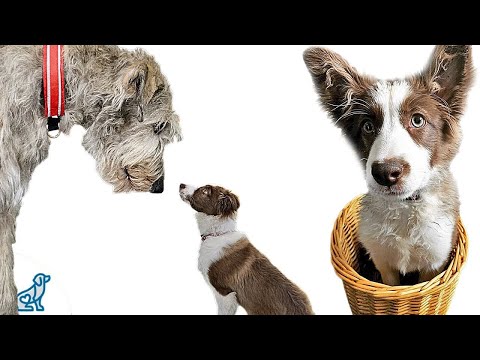
The BIG Mistake People Are Making When Socializing Their Dog
McCann Dog Training · 18:00 · Mar 2020
Kayl McCann presents alongside Meg's puppy Highlight, reframing socialisation as a much broader challenge than dog-to-dog contact. She covers stress signals at 2:20–2:35 (ears pinning back, refusing treats), explains why sessions for an eight-week-old should last no more than five to ten minutes 1:56, and argues that over-emphasising dog play at this age can inhibit a puppy's engagement with its owner 6:10.
Why it ranks here: No other video in this set names the core misconception so clearly at the outset 0:00–0:48 and then backs it up immediately with something practical: if a puppy stops taking food, it has crossed its stress threshold and the session needs to change. Treat refusal as a stress meter is a rule any owner can apply in real time without guessing. McCann also covers the everyday exposure work most guides skip — sewer grates 12:01, birthday parties 14:00, fresh snow 15:11 — framing all of these as socialisation opportunities that require no other dog at all. That range gives the video a staying power the more dog-focused entries lack.
~17 min · beginner · no equipment needed
2
Most thorough
Avoid errors socializing your puppy with this 30 min in depth guide
Kikopup · 30:38 · Feb 2020
Emily Larlham of Kikopup presents a 30-minute structured walkthrough of mindful puppy socialisation, built around the principle that flooding a puppy with experience is as harmful as depriving it. The video covers how to read body language at every stage, how to choose appropriate mentor dogs, how to introduce two dogs on leash, and how to manage a puppy that finds other dogs overwhelming — with footage of her own dogs at different points in the process.
Why it ranks here: The diving analogy at 4:39 — dropping a novice diver 60 feet instead of letting them find their depth — is the clearest single explanation in any of these videos for why well-meaning owners accidentally create fear. The body language progression at 17:07–18:00, moving from lunging and fixating to looking away and responding to a cue, gives viewers a concrete scale to assess their own dog. The double-barrier technique at 26:56 for introducing a new dog when you are not certain of the outcome is a practical safeguard no other ranked video mentions. Commenters with trainer credentials describe this as the definitive positive-reinforcement socialisation resource.
~30 min · beginner–intermediate · no equipment needed
3
Best for dog-to-dog introduction mechanics
How to Socialize your Puppy!
Zak George’s Dog Training Revolution · 9:46 · Oct 2014
Zak George films a real dog-to-dog introduction in a park, pairing Ripley — a rescue described as nervous around other dogs — with Cheeto, a confident, sociable dog well known to regular viewers. George covers why dog parks overwhelm most puppies 2:26, how to use a long lead for safety 7:48, how to read body language and eye contact during a greeting 5:28–5:35, and why toys should be removed from the introduction area 6:35.
Why it ranks here: Pairing a nervous dog with a calm one is the right model for most real introductions, and watching Ripley gradually settle across the session illustrates the process honestly. George notes at 5:04 that nervous dogs often need two to three minutes to warm up even to a new person, which sets realistic expectations. The advice to ask an owner how their dog behaves with other dogs before the dogs meet 3:46 is specific and widely applicable. The section at 8:03 on exposing puppies to a wide variety of people — men, women, people of different sizes — rounds out the dog-focused content with the people-exposure side of socialisation.
~9 min · beginner · long lead optional
4
Best for under-socialised or older puppies
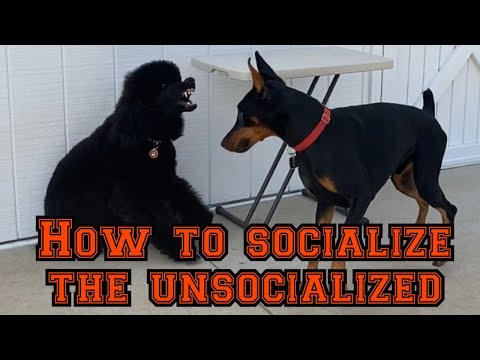
Learn how to socialize quickly but safely
Beckman's Dog Training · 10:01 · Jul 2021
Beckman's Dog Training works with Theo, an eight-month-old poodle described as extremely under-socialised, introducing him across a single session to a sequence of calm dogs — Prince, Gilly, Leo, Mikko — on leash in a controlled outdoor setting. The trainer explains why dog parks cannot serve this purpose 1:17, why the window becomes very difficult to work around after twelve months 3:33, and how to read the difference between a fearful response and an aggressive one.
Why it ranks here: This is the only video in the set that deals honestly with a puppy that has already missed the prime window. The session with Theo is imperfect — he is overwhelmed at several points, and the trainer says so plainly rather than cutting away — which makes it more instructive than a success reel. The observation at 7:01 that a dog has to be able to smell another dog before it truly understands what dogs are communicates something concrete and specific. The urgency about the narrowing window is evidenced by Theo's struggles in the same footage, not just asserted.
~10 min · beginner · long lead recommended
5
Best for pre-vaccination socialisation
How to Socialize a Puppy Before Vaccinations
How To Train A Dream Dog · 11:36 · Jan 2020
How To Train A Dream Dog addresses the specific dilemma of socialising before a puppy has completed all three vaccination rounds, offering six structured tips: starting with familiar environments inside the home 3:22, graduated car rides, controlled playdates with one or two known vaccinated dogs 6:03, low-traffic pet store visits, treat tasting to engage all five senses, and sound exposure using recordings at gradually increasing volume 9:12.
Why it ranks here: The vaccine guidance is the most precise in this set: two rounds are sufficient for playdates with known dogs, but all three rounds should be complete before public contact with unfamiliar dogs 6:19–6:34. That is a usable decision rule rather than a vague instruction to consult a vet. The point at 5:01 that reassuring a nervous puppy with soft words and petting can reward the fear rather than reduce it runs against instinct and is stated clearly enough to actually change how an owner responds in the moment.
~11 min · beginner · treats recommended
6
Best for staged public exposure
Puppy Socialization - Tips to Positively Work On Exposure Training
How To Train A Dream Dog · 14:17 · May 2021
How To Train A Dream Dog presents a step-by-step framework for taking a puppy into public spaces without overwhelming it, using a pet store as the worked example: parking lot first 4:26, then the entrance, then progressively deeper inside across multiple short visits 6:13–6:27. The video identifies four common mistakes — too much too soon 4:41, starting too late 9:20, relying on dog parks 10:18, and ignoring stress signals — and makes the case for sessions that are frequent but brief 7:32.
Why it ranks here: The staged approach is more concretely specified here than in any other ranked video. The stress rule is practical: if the pup is not taking treats or is visibly tired, retreat rather than push through 5:10. The tipping-point rule at 6:42 — if at any time your pup tips over threshold, go back a step — gives owners a clear decision framework in the moment. There is some overlap with the same channel's pre-vaccination video, but the public-exposure mechanics are distinct enough to warrant both.
~14 min · beginner · treats recommended
7
Best short watch for people-and-places exposure
How to Socialize your NEW PUPPY with People and Places
Zak George’s Dog Training Revolution · 5:41 · Sep 2016
Zak George takes Leia, a four-month-old puppy described as nervous in new situations, into a garden centre and demonstrates real-time public socialisation: using treats to measure comfort, creating distance when a nearby dog starts barking 3:55, and holding a nervous puppy through a stressful moment rather than forcing ground contact 4:12. At under six minutes it is the most time-efficient entry in the set.
Why it ranks here: The moment at 4:15 where Leia refuses a treat near the barking dog, then accepts one a few seconds later near the chickens, makes the treat-as-comfort-gauge concrete in a way that description alone cannot. George's decision to hold Leia while walking past the disturbance illustrates adaptive management without stopping to explain it. Best used as a companion to McCann or Kikopup rather than a standalone guide.
~6 min · beginner · treats recommended
8
Best for understanding long-term consequences
Puppy Socialization is the Most Important Part of Dog Training!
Stonnie Dennis · 34:03 · Mar 2019
Stonnie Dennis films a working session on his property with multiple dogs at different socialisation stages — from young Blue Bell to Mr No Name, an older, under-socialised dog — showing the contrast between dogs who had good early exposure and those who did not. The video argues that formal obedience training fails in distracting environments unless socialisation has laid the groundwork first.
Why it ranks here: The side-by-side comparison of well-socialised and under-socialised dogs working through the same tasks is the strongest argument in this set for why the early window matters. Dennis marks the 7-to-12-week range at 11:32 as the prime window; the 'but' that follows in the transcript suggests the work is not hopeless if that window is missed, just considerably harder. The transcript is heavily downsampled from 33 minutes, which limits individual moment citations, but the argument is clearly evidenced by the footage described throughout.
~33 min · beginner–intermediate · outdoor space helpful