Most people try the same fix no matter why their dog is barking. That's why most people fail. Yelling 'quiet' at a frightened dog and giving a treat to a bored one will both backfire. The videos that actually help start by asking what type of barking you are dealing with.
Short verdict
For most households, McCann Dog Training's complete indoor guide is the right first watch: it names three distinct barker types and shows a different solution for each, so you stop applying the wrong fix. If your dog is clearly frightened rather than territorial or attention-seeking, the Cesar 911 episode does more to address how the owner's emotional state feeds the anxiety. For crate barking overnight, McCann's dedicated short video cuts straight to the problem. Add the Zak George session if your dog reacts to joggers, cyclists, or other dogs outside; it shows the training in real time, including the inevitable setbacks.
The ranking
1
Best overall for indoor barking
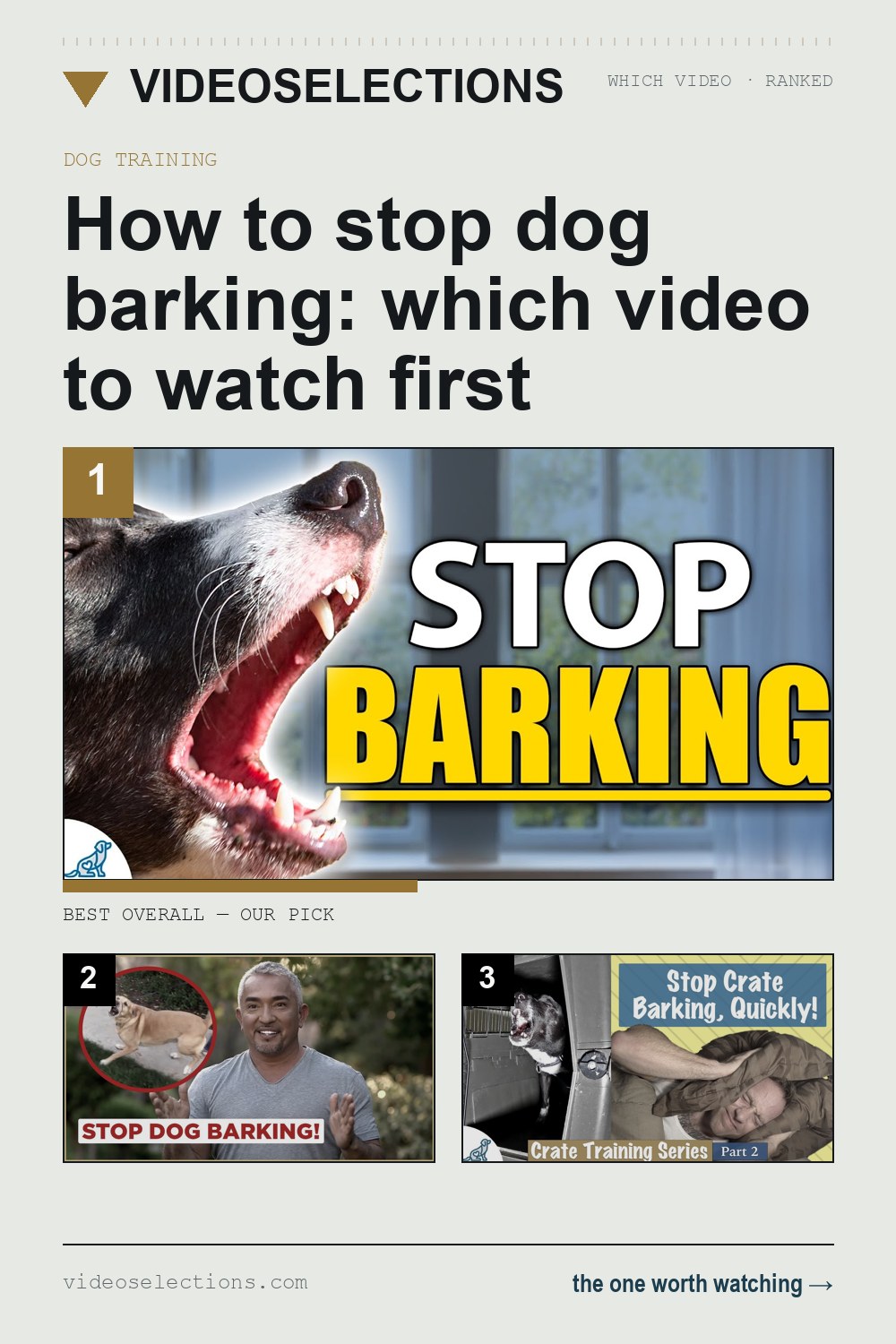
STOP Your Dog From Barking Indoors - Complete Guide
McCann Dog Training · 13:07 · Jan 2022
Instructor Carol at McCann Dog Training names three types of problem barker: the bored barker (relaxed, self-rewarding), the back-off barker (stiff, alert, often fear-driven), and the buddy barker (demanding attention from you directly), then prescribes a different response for each, explaining the common mistakes before demonstrating what works. She shows how to move the dog away calmly and cue a lie-down for the bored barker 3:37, how to acknowledge the alert and then take the lead yourself for the back-off barker 8:01, and why withdrawing all attention is the only effective answer for the buddy barker.
Why it ranks here: This is the only video in the set that explains why the same tactic fails with different dogs. The point that yelling 'quiet' associates that word with barking in the dog's mind 1:56, and that distracting a bored barker with a treat teaches it that barking produces food 2:14, is specific enough to change habits immediately. The back-off section goes furthest: Carol argues at 7:53 that correcting a frightened dog destroys trust without touching the fear. That distinction separates this guide from every other in the evidence pack.
~13 min · intermediate · covers the three indoor barking scenarios most households encounter
2
Best for fear-based barking
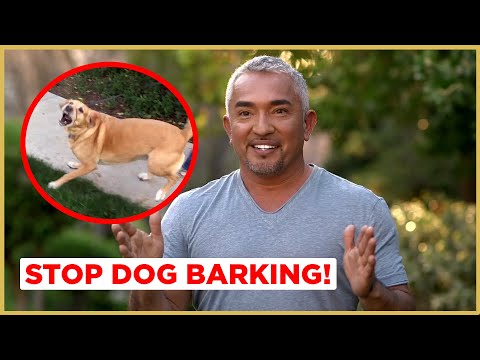
How to Stop Dog Barking! | Cesar 911
Cesar Millan · 12:32 · May 2021
Cesar Millan visits Leslie, a widow whose yellow lab Buddy barks incessantly at anyone entering the house — a pattern that has stopped her ten-year-old grandson from visiting. Millan identifies Buddy as fear-driven from the moment the dog uses the sofa as a hiding place 8:07, then walks Leslie through three changes: putting Buddy on a leash to shift his state of mind 6:41, withdrawing all affection when he growls rather than comforting him 6:50, and using a calm snap or touch at the neck to break the barking cycle before each knock at the door.
Why it ranks here: The case-study format shows something instructional videos cannot: how an owner's emotional state feeds directly into a dog's anxiety. Leslie stares at Buddy while trying to calm him, and Millan explains at 10:00 that holding that gaze keeps both of them tense. The repeated door-knocking exercise, run four or five times in sequence, makes the learning curve visible; you can see the dog settle faster with each pass. The central lesson, that treating a dog like a small human is the root cause here 12:10, is stated plainly and reinforced throughout the episode.
~12 min · no prior training needed · best suited to fear-driven or over-attached dogs
3
Best for crate barking at night
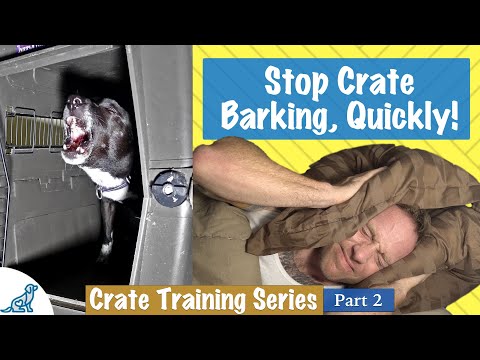
How To Stop Your Dog From Barking In Their Crate At Night
McCann Dog Training · 5:30 · Sep 2018
Ken Steepe at McCann Dog Training addresses a puppy or dog barking in its crate overnight, opening with the point that waiting it out is not a workable plan because barking is self-rewarding 0:03. He recommends using the crate during the day first so the dog does not associate it exclusively with night-time isolation, then gives three interrupters in order of escalation: a sharp verbal 'ah ah' 2:38, tapping the side of the crate 3:08, and clipping a long line to the crate door so you can jingle it from bed and praise the instant of quiet 3:44.
Why it ranks here: The long-line technique solves the timing problem that defeats most owners: you can interrupt and then praise without getting up and thereby rewarding the barking with attention. Several commenters report their dog quietened within five to ten minutes — consistent with how the praise-capture logic works. Narrow in scope, but that focus is its strength.
~5 min · easy · specifically for crate or overnight barking
4
Best vet-perspective overview
How To Quickly Stop Dog Barking
Veterinary Secrets · 6:30 · Feb 2013
Dr Andrew Jones (Veterinary Secrets) categorises the causes of excessive barking — play, warning, anxiety, boredom, environmental noise — before covering what not to do: yelling, shock collars, and giving positive attention immediately after barking 1:28. He demonstrates the 'come when called' sequence as the core redirector 2:04, recommends keeping the dog away from its trigger environments, and prescribes at least 30 minutes of aerobic exercise twice daily 4:02 on the grounds that it produces calming hormones 4:06; he closes with the Tellington TTouch ear-stroke technique 4:24 and two natural supplement options.
Why it ranks here: The veterinary frame is useful for owners who want cause-and-effect explained before they start training. Jones also confirms that debarking surgery is outlawed in the United Kingdom as a form of mutilation 1:00, worth knowing if anyone has suggested it. One concern raised in a highly liked comment is worth heeding: calling a barking dog over and rewarding it on arrival may, over time, teach that barking summons a treat; reward only sustained quiet, not the transition from barking.
~6 min · introductory · useful first watch for owners who want the physiology alongside the training
5
Best for outdoor and reactivity barking
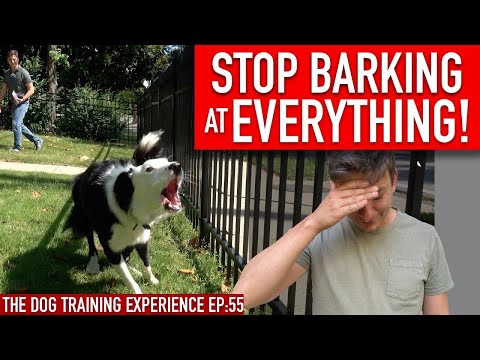
How to Train Your Dog to STOP BARKING at EVERYTHING That Moves!!
Zak George’s Dog Training Revolution · 14:55 · May 2020
Zak George films a live training session with his own dog Inertia in their front garden, working through her barking at joggers, cyclists, and passing dogs. He uses a 30-foot long lead 5:09 to give her freedom while retaining control during outbursts, and spends the session teaching her to redirect attention to him after spotting a distraction rather than escalating to a full bark.
Why it ranks here: George shows the pre-bark signal to watch for — eyes lighting up, ears shifting 8:25 — and explains that catching that moment is the goal, far more productive than trying to recover after an outburst has started 8:17. The session is not edited for success: Inertia lunges, ignores him, and George apologises sheepishly to passing strangers 4:31. That honesty makes the advice credible. He states plainly that many repetitions over time are required 9:07, which is the realistic expectation this topic needs.
~15 min · intermediate · best for dogs reactive to outdoor stimuli such as joggers, cyclists, or other dogs