Making a cutting board spans from a quick live-edge slab needing little more than a bench saw, to a five-day pattern build with exotic woods and custom jigs. Most tutorials either assume a full workshop — jointer, planer, drum sander — or skip the grain-type decision that shapes every choice that follows. Picking the right video first saves both timber and frustration.
Short verdict
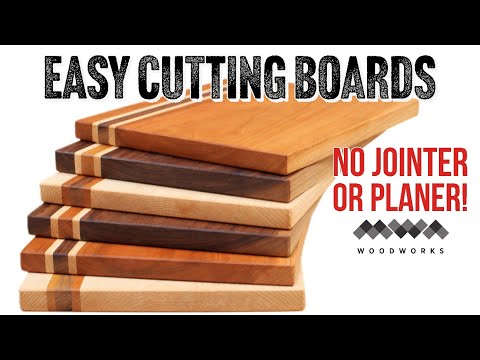
For most people beginning their first build, MWA Woodworks' minimal-tools video is the right entry point. It solves the problem most beginner tutorials create by using pre-surfaced hardwood lumber, making the jointer and planer steps unnecessary. A high school woodshop teacher reports using it with 150 students each year. Once you have one board made, the same channel's five-tips follow-up adds the jointer fold trick and a wax finish without repeating material. If you want to understand grain types before picking up a tool, Casual Builds covers face, edge, and end grain in the first two minutes.
The ranking
1
Best overall · best with limited kit
How to Make Cutting Boards with Minimal Tools
MWA Woodworks · 10:00 · Jan 2021
Matt (MWA Woodworks) builds three striped cutting boards from walnut, maple, and cherry using only a table saw, relying on pre-surfaced hardwood lumber to skip the jointing and planing stages. The build covers ripping strips to width, a Titebond III glue-up with cauls to keep everything flat, hand-sanding from 80 through 220 grit, and a mineral oil and beeswax paste finish applied on all sides.
Why it ranks here: This ranks first because it explicitly removes the tool barrier that derails most first-time makers. Pre-surfaced lumber arrives flat and square, so a table saw is the only machine needed — a realistic ask for a beginner. The grain-raising step at 7:41, where the board is spritzed with water and allowed to dry before the final sand, is named and explained as a deliberate technique rather than a throwaway note; that is why the surface stays smooth after the first wash. A commenter reports using this video with 150 high school woodshop students each year.
~9 min · beginner-friendly · table saw required
2
Best for technique
5 Tips to create the PERFECT cutting board
MWA Woodworks · 8:57 · Dec 2019
Matt (MWA Woodworks) builds a walnut, maple, and cherry edge grain board while presenting five numbered craft tips: use offcuts for accent strips, fold both boards face-to-face on the jointer for a guaranteed flat joint, wait for glue to skin over before unclamping, bevel the underside with a 45-degree table saw cut, and raise the grain with water before the final wax finish. The finished board is treated with a paste of mineral oil and beeswax.
Why it ranks here: The jointer fold trick at 2:21 — placing two mating faces through the jointer simultaneously so any deviation cancels out — is the standout technique. Multiple woodworkers in the comments call it 'gold' and note they had never encountered it. It produces a seamless joint without measuring, which is precisely the step where most beginner glue-ups fail. The five-tip structure makes the video reusable: watch it once to learn, return to individual tips as needed.
~8 min · intermediate · jointer and table saw required
3
Best structured introduction
Cutting Board for Beginners | Woodworking Basics
Casual Builds · 11:03 · Apr 2020
Tim (Casual Builds) makes an edge grain walnut board while explaining all three grain orientations — face, edge, and end — including which dulls knives fastest and which shows cut marks most, before any wood is touched. The build uses a jointer, planer, table saw, and router, covering a Titebond III glue-up, chamfer routing, and a Howard's oil finish applied in three to four coats.
Why it ranks here: No other ranked video explains the grain-type decision before reaching for a tool. Tim establishes at 1:36 why end grain is best for knives and makes the trade-offs clear before choosing edge grain as the practical option — context that makes every later decision legible. The caveat is the title: several commenters flag that 'beginner' is a stretch when the build calls for a jointer, planer, table saw, and router. Anyone without that kit should start with the MWA minimal-tools video above.
~10 min · intermediate (full workshop) · jointer, planer, table saw, router required
4
Best for judging scope
I Build 3 Cutting Boards - 5 Min vs. 5 Hour vs. 5 Day
John Malecki · 34:14 · Aug 2024
John Malecki builds three cutting boards in real time: a live-edge walnut slab finished in five minutes, a striped edge grain glue-up completed in five hours, and an intricate multi-wood pattern using paduk, maple, and zebra wood completed over five days. Each tier is shot with on-screen timing and narration on what the approach demands in tools and patience.
Why it ranks here: Watching all three builds back-to-back gives a sense of which project matches your current skill and available time that no description can match. The five-minute board needs almost nothing; the five-day board needs a full workshop. Commenters are genuinely split on which result they prefer, and several favour the simplicity of the live-edge slab — itself useful information before committing to a complex build. The transcript for this video is heavily downsampled, so specific technique steps are harder to verify here than in the shorter tutorials; treat it as context for scope and design, then return to the focused builds above.
~34 min · all levels · tools vary by tier
5
Best decorative technique
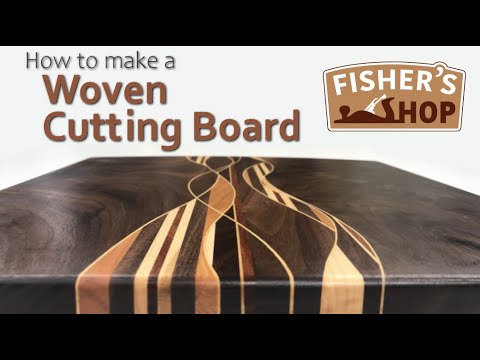
Woodworking: How to Make a Woven Cutting Board
Fisher's Shop · 13:35 · Oct 2020
Fisher's Shop builds two woven-pattern boards from walnut and maple by cutting interlocking curves with a band saw, fitting thin filler strips into the gaps, and pressing the assembled pieces through a drum sander to level the surface before an oil finish. One board receives a live-edge addition; both show how an unusual weave pattern can be achieved without epoxy.
Why it ranks here: This is the only ranked video showing a flowing curved weave rather than straight-strip glue-ups, making it genuinely distinct from the rest of the set. The dry narration and self-deprecating humour make a technically demanding process feel approachable; one commenter called Fisher's Shop the Bob Ross of woodworking. Accurate band saw work and a drum sander are both required. Watch it when a standard striped board no longer feels like a challenge.
~13 min · advanced · band saw and drum sander required
6
Best single-piece build
Walnut Cutting Board #woodwork #walnut #cuttingboard #ireland #craft #handplane #carving
Eoin Reardon · 1:30 · Sep 2025
Irish woodworker Eoin Reardon shapes a circular cutting board from a single piece of walnut using a spoke shave for the edge chamfer, a gouge to carve a serrated decorative pattern around the rim, and a hand plane to re-flatten the board after an unplanned warping incident. Three coats of food-safe oil are applied at 1:15.
Why it ranks here: The only ranked video requiring no glue-up at all. One good piece of timber and a set of hand tools is everything needed. The narration is candid about the setback — a microwave treatment intended to kill woodworm caused warping, requiring a full re-planing and a restart of the carved edge detail — which makes the 90-second runtime more instructive than it looks. The serrated gouge pattern and spoke shave chamfer are accessible to anyone comfortable working away from machines.
~90 sec · intermediate hand tools · spoke shave, gouge, hand plane required