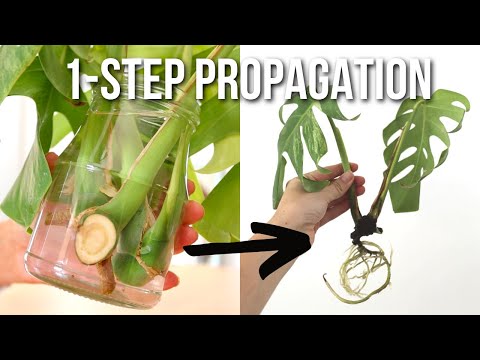
Monstera propagate readily in water, so readily that dozens of videos show the same basic steps without much variation. Two things most skip: what happens to the mother plant after you cut, and the difference between a tip cutting and a middle-stem cutting — they behave quite differently once in water, and only one video here explains why.
Short verdict
Start with Techplant's detailed two-method video (Techplant). It is the only one in this pack that runs water and sphagnum moss propagation as a side-by-side experiment from the same plant, documents root development in both, and films the mother plant recovering and pushing new growth. For a step-by-step water-only walkthrough that follows through to soil planting, Crazy Plant Guy (Crazy Plant Guy) is the clearest companion piece.
The ranking
1
Best overall
How To Propagate MONSTERA DELICIOSA 2 EASY Ways (DETAILED)
Techplant · 10:01 · Apr 2020
Techplant propagates a monstera deliciosa using two methods simultaneously — a water jug and sphagnum moss — starting the experiment on 1 March and filming results through 22 April. The video covers node identification, cutting size decisions, what to do with aerial roots beforehand, and which medium produced roots faster.
Why it ranks here: The closest thing to a controlled experiment in this evidence pack. Running both methods from the same plant at the same time gives an honest comparison rather than a single-method endorsement. Crucially, it also films the mother plant pushing out new growth 9:15, which multiple commenters single out as the one thing no other propagation video showed them. Sphagnum moss produced roots that were "hefty... coiled up" 5:45 while the water jug also rooted well — both work, but you can see the difference. The practical detail at 2:16 — cutting an opening in the side of the water jug so roots can exit cleanly — is small but saves real frustration at potting-up time.
~10 min · hands-on · node cutting required
2
Best for water propagation, start to finish
Propagating My Monstera Deliciosa | Houseplant Update Spring 2019
Crazy Plant Guy · 11:38 · Mar 2019
Crazy Plant Guy walks through water propagation on a large, healthy monstera deliciosa from cut to soil planting. He locates the aerial root, cuts half an inch to an inch below it 2:21–2:25, places the cutting in a clear jar near a bright window, and returns when roots are roughly 4 inches long before planting in a mix of 70% potting mix with orchid bark, perlite, and a small amount of cacti soil.
Why it ranks here: The most methodical water-propagation walkthrough here. Each decision is narrated: why the aerial root matters 2:25, when to top up or change the water 4:36–4:52, and how the cutting sits in the pot at planting 8:48–8:55. Roots start appearing within 5–14 days 5:13, though as Horticulture & Me found, a winter propagation runs considerably longer. The soil mix is among the most specific in any of these videos, which is useful if you are unsure what to plant into.
~11 min · beginner-friendly · clear jar and bright indirect light needed
3
Best short explainer — tip vs middle cuttings
HOW TO PROPAGATE MONSTERA DELICIOSA PLANT IN WATER
Horticulture & Me · 3:33 · Dec 2022
Horticulture & Me takes both a tip (terminal) cutting and a middle-stem cutting from the same plant and propagates them in water side by side over roughly two months, then shows the different way each one grows on. The video is under four minutes and also covers trimming aerial roots before water propagation and keeping a rooted cutting growing in water long-term.
Why it ranks here: The only video here that explains a distinction most beginners miss entirely: a tip cutting continues growing leaves as normal 1:42, while a middle-stem cutting must generate a new plantlet from a lower node 1:57 and will take noticeably longer to produce any visible growth. That single piece of information sets realistic expectations and explains why some propagations seem stalled for weeks with no sign of progress. The tip on trimming the aerial root before propagating — because new roots grow from the wound site 0:24–0:32 — is also clearly demonstrated rather than just mentioned.
~3.5 min · quick reference · any cutting type
4
Best for water-vs-soil propagation comparison
How to grow the BEST Monstera
Kill This Plant · 8:12 · Apr 2024
Kill This Plant propagates multiple cuttings simultaneously as part of a monstera renovation, placing some in water and others directly into soil (orchid bark, horticultural charcoal, and perlite). The video revisits both sets of plants several months later with footage showing them side by side, then honestly assesses which looks better.
Why it ranks here: The long-term comparison is the value here. The water-propagated plant was "two full months behind on growth in soil" 5:52–5:56, and the first new leaf after water propagation tends to come out significantly smaller than the previous ones 3:59–4:03. Both methods produced viable plants — this is not an argument against water propagation — but the footage makes the growth lag concrete rather than theoretical. The presenter also treats the cut surface with sulphur 1:14, mentioned here and nowhere else in this evidence pack.
~8 min · intermediate · some prior monstera knowledge helpful
5
Best for bare-node or leafless cuttings
Monstera Deliciosa Single Node Propagation (0-9 Months)
Techplant · 17:27 · Sep 2022
Techplant's second propagation video tracks single monstera nodes — most with no leaves at all — across multiple growing media (sphagnum moss, perlite, leca) from zero to nine months. It documents setbacks, slow starters, and which nodes ultimately pulled through.
Why it ranks here: Relevant in one specific scenario: you have a half-dead stem, a piece with no leaves, or you want to stretch limited propagation material into as many plants as possible. The nine-month timeline is honest rather than discouraging — several nodes looked inert for months before showing movement, and the video stays with them long enough to confirm they can recover. For a healthy cutting with at least one leaf and a node, the videos ranked above are faster and more directly useful.
~17 min · patient viewer · multiple growing media compared