Mastering is the last stage a track goes through before it reaches listeners, and the step home producers most often rush or skip entirely. The common mistake is reaching straight for a limiter and pushing the volume until something sounds loud. Better results start earlier: understanding what the mix actually needs before any plugin opens.
Short verdict
Rob Williams is the right starting point for most people. His seven-step formula is the only video here that names every stage, explains why it exists, and demonstrates each tool in sequence on a real track. In The Mix covers the same ground in a single uninterrupted session, better suited to viewers who learn by following a real job rather than a structured lesson. For a professional's view of an industry session, Mike Bozzi mastering Kendrick's 'HUMBLE' shows what restrained, experience-built decision-making actually looks like.
The ranking
1
Best overall
HOW TO MASTER A SONG - 7 Steps to Loud!, FAT, & In Your Face
Rob Williams · 31:03 · Apr 2012
Rob Williams walks a single track from raw mix to finished master through seven named stages — Prepare, Fix, Enhance, Compress, Clip, Limit, Reference — explaining the purpose of each as he goes: what a compressor is doing to the low end, why you clip before you limit, and how to reference against other tracks without fooling yourself with loudness differences. He works with third-party plugins but makes clear throughout that stock equivalents will reach similar results, making the method applicable in any DAW.
Why it ranks here: No other video here gives each stage its own named slot and then demonstrates it on real audio. The referencing section from 28:53 is particularly useful: he addresses the trap of comparing tracks at mismatched volumes before assessing tone, and shows how to pull the reference down to match loudness first. Viewer comments from people with years of studio experience describe learning more from this single video than from fifteen years of prior reading, which matches what the transcript delivers. The presentation is unhurried and the reasoning behind every decision is made explicit.
~31 min · beginner-friendly · no specific DAW or plugins required
2
Best for following along
Mastering Start To Finish: A Step by Step Guide to Loud and Clear Masters
In The Mix · 25:53 · Mar 2021
In The Mix shows mastering from start to finish on a real original track, beginning with reference listening and working through EQ, limiting, loudness checking, and export to a delivered file. The presenter reasons through each plugin decision as he makes it, and the file-naming, export, and client-delivery section from 19:18–20:45 covers the professional handoff that most tutorials leave out entirely.
Why it ranks here: Where Rob Williams explains a formula, this video shows an uninterrupted real job. Viewers who find it easier to follow a working session than a structured lesson will find the pacing more natural. The referencing section from 1:00–3:15 grounds everything that follows: the presenter listens to the track alongside a reference, identifying specific needs before any plugin opens. The section on standing your ground over payment at 24:47 is a practical addition none of the other ranked videos includes.
~25 min · intermediate · downloadable project files available
3
Most practical shortcut
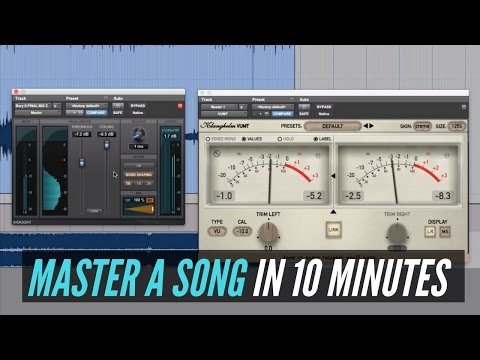
How To Master A Song In 10 Minutes - RecordingRevolution.com
recordingrevolution · 18:44 · May 2017
Graham from Recording Revolution reduces mastering to four tools: a reference track, an EQ with moves no larger than 1.5 dB, a compressor configured for parallel compression via the plug-in's dry/wet knob, and a limiter monitored against an RMS/VU meter targeting around −10 RMS. All four tools are either free or bundled with common DAWs, and the finished master of the tutorial track was subsequently released on Spotify.
Why it ranks here: The strongest single moment is the referencing section from 1:38–4:42, where Graham explains that tone comparison only works when both tracks are first volume-matched. That insight alone reframes how to use references. The four-tool approach will not satisfy everyone, but it produces a competent master without requiring specialist plugins. The repeated emphasis on subtlety at 5:17–5:29 is a useful counterweight to tutorials that reach for dramatic EQ moves.
~18 min · beginner · free or bundled plugins; no specific DAW required
4
Best professional demo
Mastering Kendrick Lamar's 'HUMBLE' with Mike Bozzi
Mix with the Masters · 10:01 · May 2021
Mike Bozzi walks through his master of Kendrick Lamar's 'HUMBLE', naming specific EQ decisions: a boost at 800 Hz and 1.6 kHz for midrange presence, a 0.5 dB cut at 40 Hz on a shelf to control the low end, and a 4 dB air shelf at 24 kHz to open the top without touching vocals, hats, or snares. The video includes before-and-after playback at 3:24–4:31, and Bozzi explains his broader approach: getting the track as loud as possible until he hears it degrading, then backing down in 0.5 dB increments.
Why it ranks here: This is the only video here where a named professional shows specific numbers on a commercially released track. The EQ decisions at 2:08–3:02 are narrow and concrete, explained with reference to what Kendrick's voice actually needs rather than generic mastering theory. Bozzi's comment at 6:52–7:25 — that he reads nothing except VU meters and his ears, and that 25 years in one room is itself the calibration tool — is an honest account of how professional mastering skill is actually built. The session is not a workflow you can replicate directly, but it demonstrates what experienced restraint sounds like in practice.
~10 min · professional context · hardware console studio; instructive rather than a replicable workflow
5
Best conceptual foundation
Are You Listening? Ep. 1 | Audio Mastering Basics
iZotope, Inc. · 13:53 · Feb 2019
Jonathan Wyner opens with the question of what mastering actually is and why it is a separate discipline from mixing, using audio examples and asking viewers to identify differences before he explains them. The video covers level versus loudness, how genre shapes a track's loudness potential, and why mastering is described at 12:06 as a 'game of inches' where a 2 dB move is already large.
Why it ranks here: This is the right video to watch before the others if the concept of mastering is still unclear. The section on loudness potential at 8:54–9:21 is the clearest explanation here of why a solo piano recording and a dense electronic track cannot be mastered to the same loudness level without one of them losing something. Wyner also addresses the mixing-versus-mastering separation directly, a question the tutorial videos assume the viewer has already resolved. The iZotope product placement is present but does not distort the conceptual content.
~13 min · introductory · no prior reading needed; not a hands-on tutorial